Legacy banking offers stability, but cloud-based banking provides the speed, agility, and innovation needed to stay competitive in the modern market.
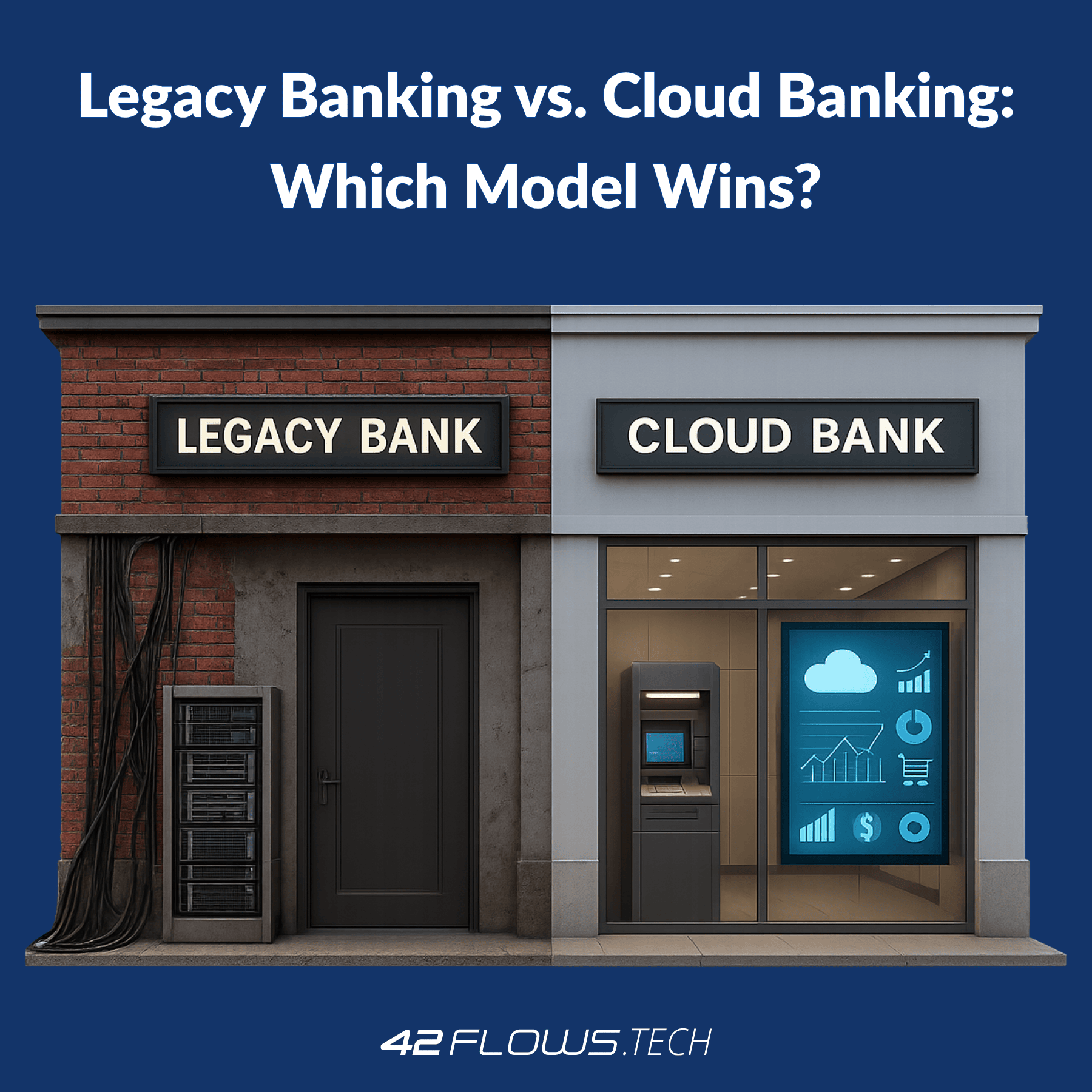

The banking industry is at a crossroads. While legacy banking systems have powered financial institutions for decades, they are increasingly being challenged by cloud-based banking solutions that offer flexibility, scalability, and efficiency.
For banks and fintech companies, the choice between traditional on-premise infrastructure and cloud banking is not just about technology—it’s about business strategy. But which model is better? And how can banks transition without disrupting their operations?
This article compares both approaches, highlighting their strengths, weaknesses, and the future of banking infrastructure.
Legacy banking systems refer to on-premise, monolithic infrastructures that have historically been the backbone of financial institutions.
Verdict: Legacy banking is stable but rigid. It is becoming increasingly difficult for financial institutions to keep up with changing market demands while relying solely on traditional systems.
Cloud banking refers to digital-first, API-driven architectures that allow banks to operate flexibly, scale quickly, and integrate new technologies seamlessly.
Verdict: Cloud banking provides the flexibility and agility that modern financial institutions need, but migration must be managed strategically to mitigate risks.
| Feature | Legacy Banking | Cloud Banking |
|---|---|---|
| Scalability | Limited | Highly scalable |
| Cost Efficiency | High maintenance costs | Lower operational costs |
| Security | Strong but rigid | Advanced, but requires strict compliance |
| Innovation | Slow adoption of new tech | Fast integration with fintech and AI |
| Compliance | Well-established frameworks | Must align with evolving regulations |
| Deployment Speed | Lengthy development cycles | Rapid updates and rollouts |
While legacy banking still has a role, particularly for established institutions with extensive compliance frameworks, cloud banking is the future. The real question is how to transition effectively.
For many banks, the answer is not choosing one over the other but adopting a hybrid model—blending traditional banking infrastructure with cloud capabilities.
This approach allows banks to modernize without fully abandoning their legacy infrastructure.
The debate between legacy and cloud banking is not about picking a winner—it’s about finding the right balance. While legacy systems provide stability, cloud banking delivers the speed, flexibility, and innovation needed to compete in today’s market.
Financial institutions looking to transition to the cloud must have a clear migration strategy, ensuring compliance, security, and minimal service disruptions.
At 42Flows, we help banks and fintechs integrate cloud-based solutions, develop API-driven architectures, and modernize their infrastructure without disrupting operations.
If your institution is planning a cloud transition, let’s talk. Contact us at success@42flows.tech to explore a strategy that fits your needs.
Let’s talk. Just enter your details and we will reply within 24 hours.

 Maksym Popov