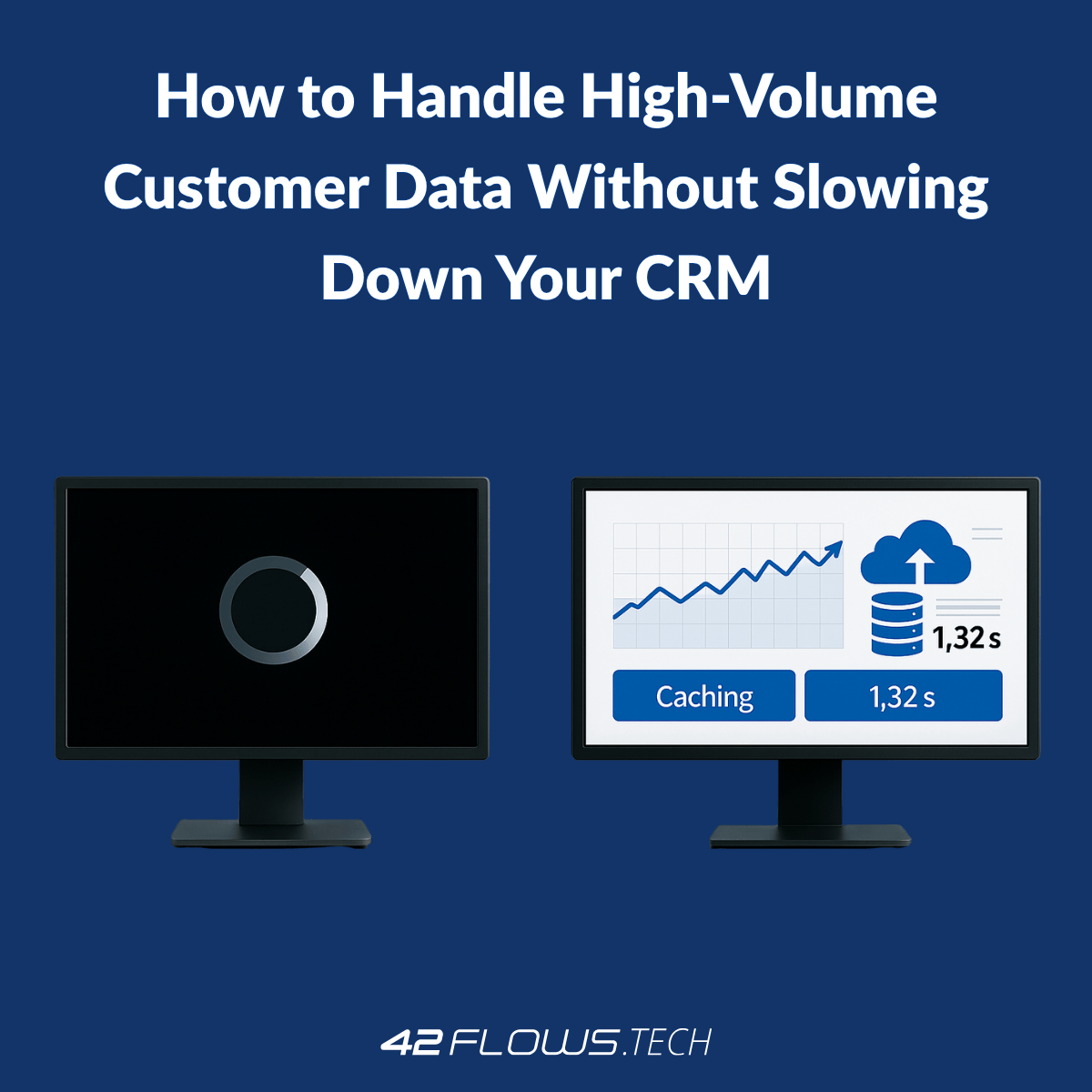
For businesses managing hundreds of thousands or even millions of customers, a slow or inefficient CRM can become a major bottleneck. High-volume customer data can lead to slow query times, system crashes, and poor user experience, making it difficult for sales, marketing, and customer support teams to operate efficiently.
The challenge is not just about storing massive amounts of data—it’s about ensuring that the CRM remains fast, responsive, and scalable while handling real-time interactions, complex workflows, and analytics.
This article outlines best practices for optimizing large-scale CRM systems, ensuring they can handle high transaction loads, real-time data processing, and seamless integrations without sacrificing speed or reliability.
1. Why CRM Performance Suffers Under High Data Loads
Many CRM platforms struggle when customer data volumes increase due to:
- Inefficient database design – Poorly structured tables and excessive indexing can slow down queries.
- Lack of data archiving – Storing outdated or unnecessary records can clutter the system.
- Slow API response times – Heavy API calls from third-party integrations can overload the system.
- Ineffective caching mechanisms – Without proper caching, frequently accessed data requires repeated database queries.
- Poor system architecture – Monolithic CRM setups often lack the flexibility to scale dynamically.
Without proactive optimization, businesses experience delayed workflows, data retrieval errors, and system downtime, which impacts productivity and customer satisfaction.
2. Best Practices for Optimizing High-Volume CRM Systems
2.1 Database Optimization for Faster Query Performance
A well-optimized database is critical for a high-performance CRM.
- Use Indexing Strategically – Apply indexing to frequently searched fields to improve query speed.
- Partition Large Tables – Split large customer and transaction tables into smaller partitions to prevent slow queries.
- Optimize Query Structures – Avoid unnecessary joins and select only the required fields.
- Schedule Database Cleanup – Regularly remove or archive outdated customer data to keep queries efficient.
Example: A telecom company handling millions of customer transactions daily reduced CRM query times by 60 percent by implementing table partitioning and optimized indexing.
2.2 Implement Data Archiving Without Losing Accessibility
Not all customer data needs to be actively stored in the CRM. Data archiving helps retain historical records without overloading the system.
- Move older data to a separate archive database – Keep recent interactions in active storage, while older data remains accessible in a secondary system.
- Use cloud-based storage solutions – Shift non-essential records to cost-efficient cloud storage while keeping essential data within fast-access environments.
- Implement auto-archiving policies – Automatically move inactive customer data to an archive after a defined period (e.g., 12 months of inactivity).
Example: A financial services firm reduced CRM storage costs by 40 percent while maintaining compliance by automating historical data archiving.
2.3 API Performance Optimization for Faster Data Syncing
CRMs often interact with multiple external systems, including marketing automation, ERP, and support platforms. Poorly designed API integrations can slow down CRM performance.
- Use Asynchronous APIs – Instead of making real-time synchronous requests, process large volumes of data asynchronously to prevent system overload.
- Implement API Rate Limiting – Control the number of external API requests per second to avoid unnecessary strain on the CRM.
- Use Event-Driven Architecture – Instead of polling the CRM constantly, trigger updates based on real-time events.
- Optimize Data Transfer Payloads – Send only the necessary data to avoid bloating API calls.
Example: A retail bank using real-time CRM updates from customer transactions reduced API latency by 70 percent by switching to event-driven messaging with Kafka instead of polling-based updates.
2.4 Caching Frequently Accessed Data
Without caching, every customer lookup or report generation requires fresh database queries, leading to slow performance.
- Use In-Memory Caching – Store frequently accessed data in Redis or Memcached to reduce database load.
- Cache User Profiles & Recent Transactions – Instead of retrieving full records from the database every time, cache commonly requested customer details.
- Implement API Caching – Store API responses temporarily to prevent redundant processing.
Example: A CRM for a large e-commerce platform used caching for customer purchase history, reducing average page load times from 3 seconds to 800 milliseconds.
2.5 Scaling CRM Infrastructure for High-Volume Usage
As customer bases grow, CRM systems must scale dynamically to handle increased traffic.
- Move to a Cloud-Based CRM Architecture – On-premise CRMs struggle with scalability, while cloud-based solutions like AWS, Google Cloud, or Azure offer elastic scaling.
- Implement Horizontal Scaling – Instead of overloading a single server, distribute requests across multiple instances.
- Use Load Balancers – Automatically route traffic to the least-busy CRM server to prevent slowdowns.
- Monitor System Performance in Real-Time – Use tools like New Relic, Prometheus, or Datadog to track CRM health and optimize performance.
Example: A CRM handling over 500,000 active users per day moved to a cloud-based microservices architecture, improving uptime and reducing latency by 80 percent.
3. Future-Proofing Large-Scale CRM Systems
To ensure long-term CRM efficiency, businesses must:
- Invest in AI-Powered CRM Optimization – Use machine learning to predict peak usage times and allocate resources proactively.
- Automate Data Quality Checks – Implement validation rules to prevent duplicate or incorrect customer records.
- Integrate AI-Driven Analytics – Provide sales and marketing teams with real-time insights without slowing down the CRM.
- Regularly Test and Optimize Performance – Continuously review database performance, caching strategies, and system scalability.
Conclusion
A CRM system designed to handle high-volume customer data must prioritize speed, scalability, and efficiency. Without proper optimization, businesses risk sluggish performance, frustrated users, and lost revenue.
Key takeaways for optimizing high-load CRMs:
- Optimize database performance – Use indexing, partitioning, and cleanup strategies.
- Archive historical data – Reduce storage load without losing accessibility.
- Enhance API efficiency – Implement asynchronous updates, caching, and event-driven architectures.
- Use caching for frequently accessed data – Reduce database queries for faster response times.
- Scale CRM infrastructure dynamically – Leverage cloud-based microservices and real-time monitoring.
At 42Flows, we specialize in building high-performance CRM systems that support large-scale customer bases, seamless integrations, and real-time automation.
Looking to optimize your CRM for high-volume customer data? Contact us at success@42flows.tech to explore scalable solutions for your business.




 Maksym Popov