


In digital banking, a sleek interface is no longer enough. User experience (UX) is the defining factor that determines whether customers stay loyal to a banking app or abandon it for a competitor.

With traditional banks, customers tolerated long wait times and complex processes because there were few alternatives. But in the digital age, fintech disruptors and neobanks offer frictionless, intuitive, and personalized experiences that set new expectations.

If a banking app is slow, confusing, or difficult to navigate, users will simply switch to a competitor. UX is no longer just about design—it directly impacts retention, engagement, and revenue.

This article explores why UX is crucial for digital banking success, common UX pitfalls that drive users away, and strategies fintech companies can use to create seamless, customer-centric experiences.

1. The High Stakes of UX in Digital Banking

1.1 Why Customers Leave Banking Apps

Studies show that poor UX is one of the top reasons users abandon digital banking platforms. Common frustrations include:

  • Slow load times – Customers expect transactions to be completed in seconds, not minutes.
  • Confusing navigation – If users can’t quickly find what they need, they won’t stick around.
  • Overcomplicated onboarding – If opening an account takes too long, customers will quit before completing registration.
  • Lack of personalization – Generic experiences fail to engage users.
  • Security concerns – A lack of trust in authentication and security processes leads to app abandonment.

1.2 The Business Impact of Poor UX

A bad user experience isn’t just an inconvenience—it has direct financial consequences:

  • Increased customer churn – Users leave for banks with better experiences.
  • Lower transaction volumes – If processes are cumbersome, customers avoid using the app.
  • Higher customer support costs – Bad UX leads to more complaints and manual interventions.

For digital banks, a well-designed UX is not an option—it’s a competitive necessity.

2. The UX Elements That Drive Customer Retention

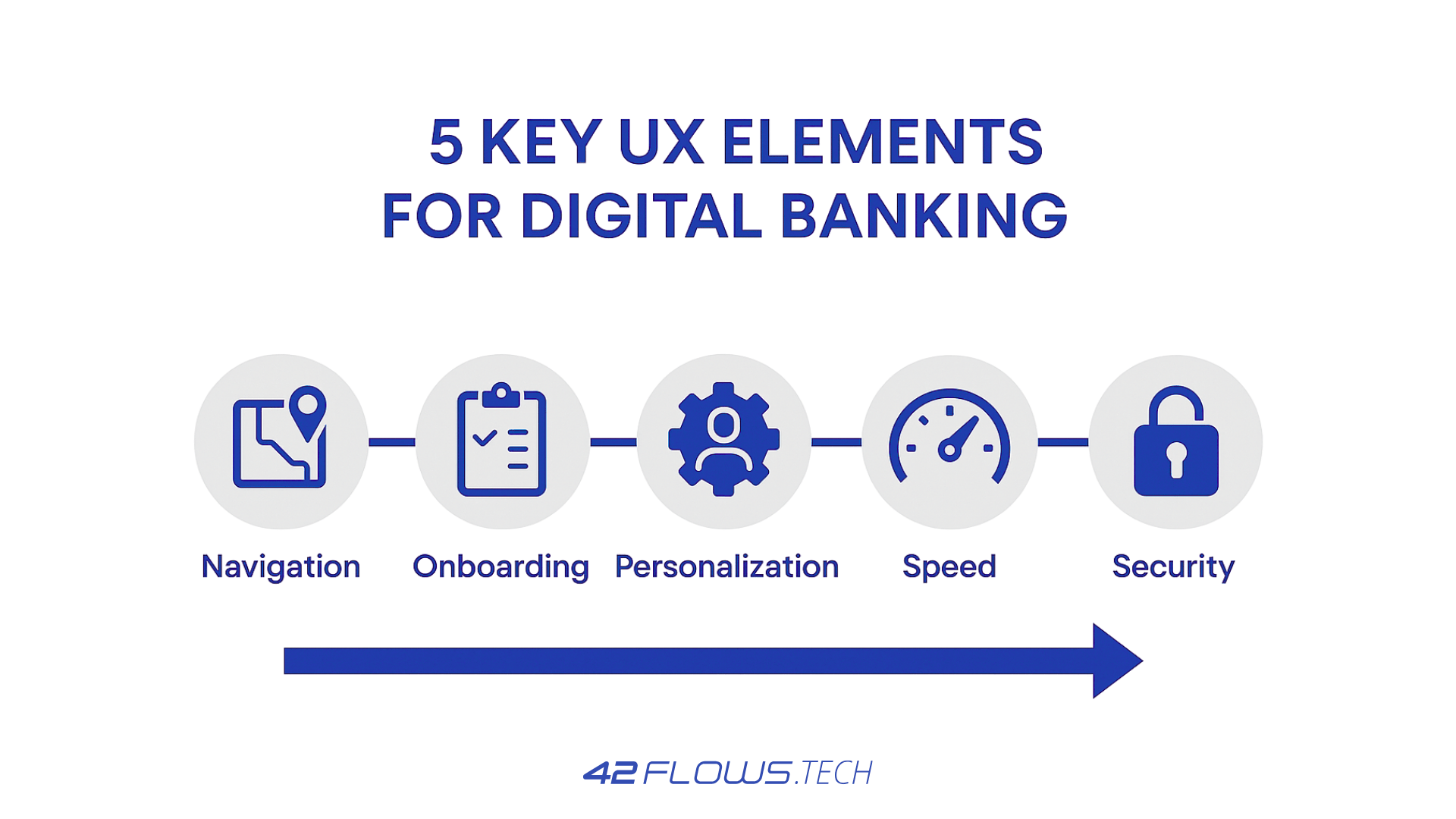
To keep users engaged, digital banks must focus on key UX principles that enhance usability, efficiency, and trust.
ux-in-digital-banking-42flows-infographic.png

2.1 Intuitive Navigation and Simplicity

The best banking apps make complex financial tasks feel effortless.

  • Minimalist design – Less clutter means faster decision-making.
  • Predictable flows – Users should instinctively know where to go next.
  • Clear action buttons – Transactions, transfers, and bill payments should be easy to access.

A study by Forrester found that financial apps with simple, intuitive designs have 30% higher engagement rates compared to those with cluttered interfaces.

2.2 Seamless Onboarding

First impressions matter. If users struggle with sign-up, they may never return.

  • Auto-fill features – Reduce manual data entry.
  • Step-by-step guides – Break down onboarding into easy-to-follow sections.
  • Instant verification – Speed up KYC (Know Your Customer) checks with AI-driven validation.

A fintech study showed that 40% of users abandon an app if onboarding takes longer than five minutes.

2.3 Personalization Through AI and Data Analytics

Customers expect banking services tailored to their needs.

  • AI-driven insights – Provide spending analytics, savings recommendations, and credit offers.
  • Context-aware notifications – Send timely alerts based on user behavior.
  • Adaptive dashboards – Let users customize their app layout for faster access to key features.

A report by Accenture found that personalized banking experiences increase customer satisfaction by 37% and drive higher engagement.

2.4 Speed and Performance Optimization

Slow-loading apps create friction.

  • Instant transactions – Reduce processing delays for payments and transfers.
  • Optimized mobile performance – Ensure smooth functionality across different devices and network conditions.
  • Pre-loading essential data – Speed up dashboard and balance displays.

Amazon found that a one-second delay in page load time reduces conversions by 7%—a lesson that applies to digital banking as well.

2.5 Secure Yet Frictionless Authentication

Users want security without inconvenience.

  • Biometric authentication – Fingerprint and facial recognition speed up logins.
  • One-tap approvals – Allow quick confirmation for transactions instead of requiring passwords.
  • Adaptive security – AI can assess risk levels and adjust security measures accordingly.

A study by Deloitte found that 74% of customers are willing to use biometric authentication over traditional passwords, reducing friction while enhancing security.

3. Real-World Examples of UX-Driven Success

Example 1: Revolut – Frictionless Finance

Revolut’s app stands out for its clean UI, fast payments, and personalized budgeting tools. Their streamlined onboarding process helped them gain over 30 million users worldwide.

Example 2: Monzo – Human-Centric UX

Monzo leverages real-time spending notifications, personalized insights, and effortless bill splitting, leading to high engagement and a strong customer community.

Example 3: Apple Pay – Invisible UX

Apple Pay’s success comes from its seamless integration, fast authentication, and one-click transactions, proving that a great UX often feels invisible.

4. How to Build a Winning UX Strategy for Digital Banking

Step 1: Research and Test Before Designing

  • Conduct focus groups to understand user pain points.
  • Perform A/B testing on design elements to optimize usability.
  • Study behavioral analytics to see how users interact with the app.

Step 2: Design for Mobile-First Experiences

  • Optimize for thumb-friendly navigation.
  • Ensure a responsive design that adapts to different screen sizes.
  • Minimize load times and battery consumption.

Step 3: Continuously Improve with AI-Driven Insights

  • Use AI to analyze user behavior and suggest UX improvements.
  • Implement machine learning models to predict user needs.
  • Personalize in-app experiences based on real-time interactions.

Conclusion

A banking app isn’t just a digital version of a bank—it’s the entire experience customers have with their financial institution. If the UX is slow, confusing, or generic, users will quickly switch to a competitor offering frictionless, intuitive, and personalized interactions.

For fintech companies and digital banks, investing in UX is investing in customer loyalty, engagement, and long-term success.

At 42Flows, we specialize in building high-performance, user-friendly digital banking experiences that combine research-driven design with seamless functionality.

Looking to optimize your digital banking UX? Let’s create an experience that keeps customers coming back. Contact us at success@51.20.208.231 to get started.

CONTACT US